AI has not reliably shortened hiring; measure the bottleneck instead
Only a third of surveyed employers said time to hire improved from 2025, while two thirds reported no change or a slowdown. The operating question is not whether a recruiter uses AI, but which stage actually releases or adds delay.
What happened
ManpowerGroup’s Q4 2026 survey of nearly 40,000 employers across 42 countries reported a mixed time-to-hire result despite broad interest in AI-enabled recruiting.
Why it matters
If leaders treat tool adoption as cycle-time improvement, they can automate screening while interviews, approvals and offers remain the real constraint.
ManpowerGroup’s Q4 2026 Employment Outlook Survey covers nearly 40,000 employers in 42 countries, including more than 6,000 in the United States. Its time-to-hire result is a useful warning against equating AI adoption with process improvement. Thirty-three percent of surveyed employers said hiring was faster than in 2025, 42% reported no change and 25% said it was slower.
HR Dive’s independent report preserves the ambiguity: tools may accelerate parts of recruiting without shortening the whole path. The survey is self-reported and observational. Employers may define AI, a vacancy and time to hire differently. It does not show that AI caused either acceleration or delay.
One clock hides several queues
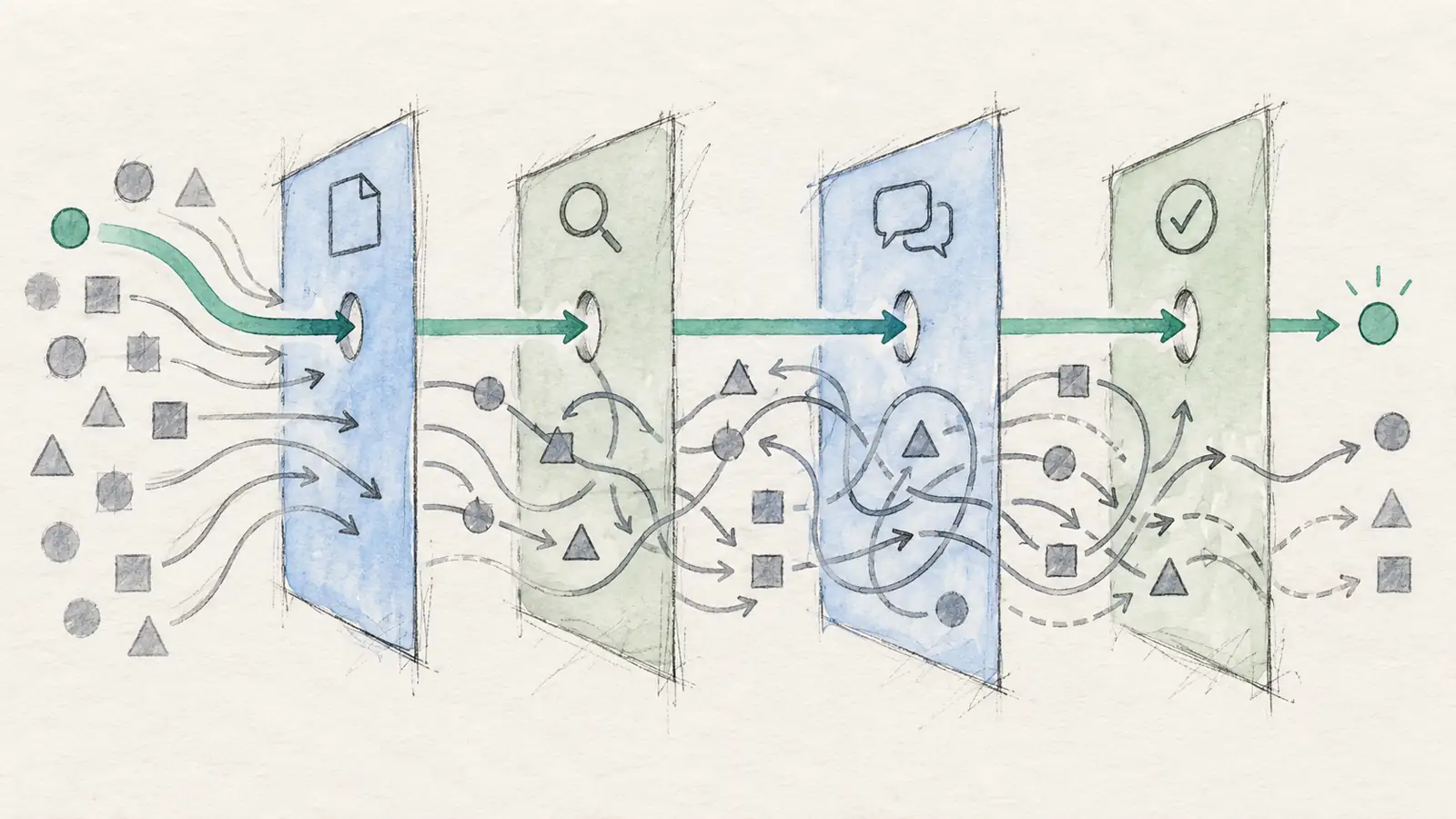
End-to-end time to hire combines requisition approval, sourcing, application handling, screening, interview scheduling, assessment, decision, background checks and offer acceptance. An AI tool may cut minutes from screening while a weekly approval meeting adds days. It may generate more candidates and increase interviewer load. It may improve scheduling but have no influence on a compensation exception.
That is why a single average is a weak operating measure. The useful unit is elapsed time and waiting time at each transition. For every requisition, record when work enters and leaves a stage, who owns the next action, whether an AI system acted, whether a person overrode it and why. Segment results by role, location, seniority and applicant volume so a shift in the hiring mix does not masquerade as process improvement.
A separate ZipRecruiter employer report found that 34% of employers said AI had sped recruiting. That is directionally compatible with the one-third faster result, but it is not a replication: the samples, questions and field periods differ. Both findings depend on employer perception rather than audited workflow timestamps. The counterevidence therefore strengthens the case for measurement rather than proving benefit.
Pair speed with quality and access
Reducing elapsed time is not useful if it increases false rejection, candidate confusion or rework. Track the proportion of screened applicants who reach interview; interviewer agreement; offer acceptance; candidate complaints; accessibility exceptions; and adverse-impact checks where appropriate. Compare AI-assisted and non-assisted pathways only when the roles and applicant pools are sufficiently similar.
Leaders should also distinguish queue time from touch time. Queue time shows organisational delay; touch time shows labour effort. A tool can reduce recruiter effort without improving candidate experience if the saved time is absorbed by a later queue. Conversely, total time can fall because the employer changed role mix or hiring demand, not because the tool improved.
The strongest counterargument is that local teams already know where delay sits. That knowledge is useful, but it is often anecdotal and changes when demand spikes or approval rights shift. A small process ledger is cheaper than buying another feature on assumption. Start with ten representative requisitions, map timestamps and overrides, and identify the transition with the largest avoidable wait.
The Skills Atlas can help define the recruiting, assessment and governance capabilities around the process. The decision is operational: require a stage-level baseline, a quality guardrail and a named bottleneck owner before treating an AI recruiting feature as a time-to-hire intervention.
A minimum experiment
Choose one role family and a fixed period. Establish the current distribution of stage times, not only the mean. Introduce one bounded AI use, preserve a comparable pathway and predefine success: less waiting at the target transition without worse quality, access or candidate outcomes. If another queue absorbs the saving, redesign the workflow before scaling the tool.