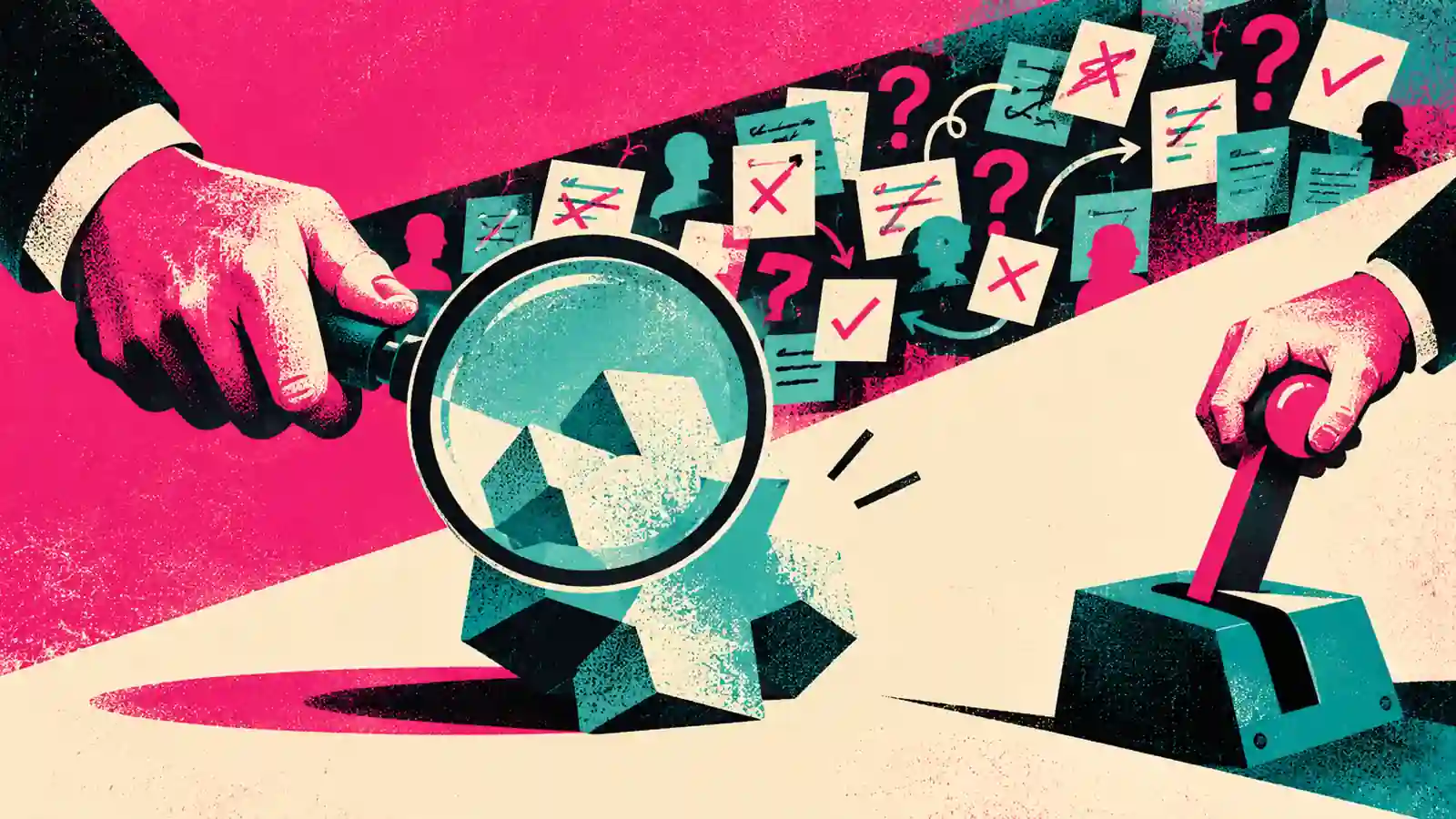
IBM surveyed 1,500 CHROs and 8,800 employees and found concern about judgement, skills erosion and hidden verification work. Self-reported gaps should lead to observed task evidence and redesigned decision rights, not a generic training response.
An ILO brief combines 21 purposively selected enterprise interviews with a survey of 1,591 professionals in China. Its self-reported gains are useful hypotheses, but workforce decisions need task baselines, comparison groups and job-quality measures.
Talogy reports that 78% of 207 HR and talent respondents worry AI may weaken future leadership skills. The result is a prompt to trace lost developmental experiences, not evidence that a leadership shortage has already occurred.
Snorkel AI’s new funding highlights demand for expert-authored datasets and reinforcement-learning environments. Buyers still need to see who exercised judgment, how rubrics changed and where automated quality checks failed.
An Indiana labour-market analysis illustrates the limits of occupation exposure measures, while Census business data track reported AI use. Workforce decisions should connect observed organisational change to a named intervention and denominator.
New York City public-school guidance limits student-facing AI while the evidence base remains mixed. A pause can reduce immediate risk, but it should define what evidence, safeguards and learning outcomes would justify continuation, redesign or exit.
A large UK workforce survey reports broad GenAI exposure, while other research shows uneven workplace adoption. Leaders need task-level measures of repeated, governed use before declaring a process transformed.
A Reuters/Ipsos poll found broad concern about serious AI harm and support for a slower pace. Leaders should use the result to choose questions and audiences, not to infer technical risk or set product gates.
Reports of distress among AI safety staff point to work design, escalation and exposure controls. Employers should manage the hazard while preserving protected dissent and incident evidence.
Citizens Advice found stress, delay and abandonment when people could not reach a human in essential services. Automation should be judged by verified resolution and safe handoff, not containment alone.
Meta is testing contractors who can complete some Muse phone calls. The control boundary must follow the task from model to person, with consent, purpose limits and an auditable return path.
Deloitte estimates UK workers spend nearly £1 billion a year on AI tools, while many users receive no training. Personal spending reveals unmet access and workflow demand—but it does not prove business value.
One senior vacancy combines agent engineering, sales operations and evaluation. It is useful evidence of a hybrid operating model, but one employer’s posting cannot establish broad demand.
Reports say the government is considering restrictions in public offices. A workable policy should govern recording, recognition and data flow by space while protecting legitimate accessibility uses.
Claude Code Projects can coordinate parallel cloud threads, each on its own branch. The bottleneck moves from producing changes to sequencing, testing and accepting them.
A Pew survey across 37 countries finds expectations tilted toward job loss. Leaders should treat that sentiment as evidence about trust and change capacity, while keeping employment decisions tied to observed tasks and outcomes.
Fewer than one in ten surveyed employees said their organisation’s code explicitly covered AI or technology ethics. The gap is not solved by adding a paragraph; workers need examples, boundaries and an escalation route they can use.
SB 1050 moves synthetic-performer disclosure into the advertising workflow. The useful response is an asset-level control before release—not an assumption that a label settles consent, quality or the role of human talent.
Bringing chat, Cowork and document creation into one interface removes friction for users. It also means a conversation can cross from advice into file access, state-changing work and export without a visible application boundary.
Global and LinkedIn data point to persistent underrepresentation in AI work and leadership. The actionable unit is not a generic pipeline promise, but the conversion and loss rate at each talent decision.
A new Brookings synthesis argues that exposure does not equal viable automation and that policy should track changes in expertise and opportunity. Employers can use the same logic: fund targeted pilots when measurable task, wage and mobility signals cross agreed thresholds.
Indian IT firms are reporting more outcome-linked deals as automation compresses effort. The commercial shift is real but limited: most AI pricing still measures effort or output, and disputed attribution can turn a promised outcome into a contract fight.
A UK careers discussion highlights resilient work in engineering, care, education and research. The useful decision is not to predict a safe occupation for 45 years, but to build transferable capability and evidence of adaptation.
The essay calls for new institutions, “Human Reserved” work and taxes on AI tokens and robots. The proposals widen the policy menu, but workforce decisions need thresholds, distribution evidence and democratic authority.
Almost 30% of surveyed workers used generative AI, yet employer training reached fewer than half. The sharpest signal is not adoption alone, but who gets access and who captures the saved time.
CompTIA estimated 86,000 more technology workers across the economy while technology companies cut about 14,700 positions. The apparent contradiction is a measurement lesson, not proof of an AI jobs boom.
OpenAI reports far more agent use, code and experiments inside its research organisation. Its own methods note explains why activity metrics are not the same as validated scientific progress.
New graduate-outcomes figures show fewer computer science graduates entering coding roles. The data is a curriculum and early-career design signal, but it does not isolate AI as the cause.
OpenAI's sector product combines financial datasets, firm templates and enterprise controls for bankers and researchers. That makes entitlement design and review evidence part of the job architecture.
The provider says AI was used across reconnaissance, exploitation and exfiltration, sometimes through multi-agent workflows. Defenders need faster adaptive loops, but the evidence remains provider-observed and selectively disclosed.
A Taggd–CII report says 52% of surveyed GCCs plan to expand in FY27, while critical roles remain slow to fill and 80% offer generative-AI training. The numbers point to pipeline design, not a single shortage score.
The IT services group says AI-created productivity freed capacity equivalent to 20,000 employees and that people were redeployed. The decision signal is in the new work and outcome measures, not the headline number.
Design Economy 2026 reports 2.27 million UK design workers in 2025 and 40% GVA growth since 2019. Those are important baselines, not a clean test of generative AI’s employment effect.
A five-country LinkedIn comparison finds a wider junior-hiring gap in occupations designed to combine AI-replicable and human skills, while broader declines argue against a simple AI-replacement story.
The framework update is still in development, but its emerging direction points towards responsibility, supervision and role design rather than a catalogue of fashionable AI tools.
OpenAI's administrative data shows how activity spreads across firms, roles and tasks; it does not measure productivity, completed work or role redesign.
The binding law separates provider duties from deployer duties and machine-readable marking from disclosures people can perceive. The Commission's guidance helps, but it is not the law itself.
Regulation (EU) 2026/1744 sets different dates for Chapter III, Sections 1–3 duties for Annex III and Annex I high-risk systems. Other AI Act clocks continue.
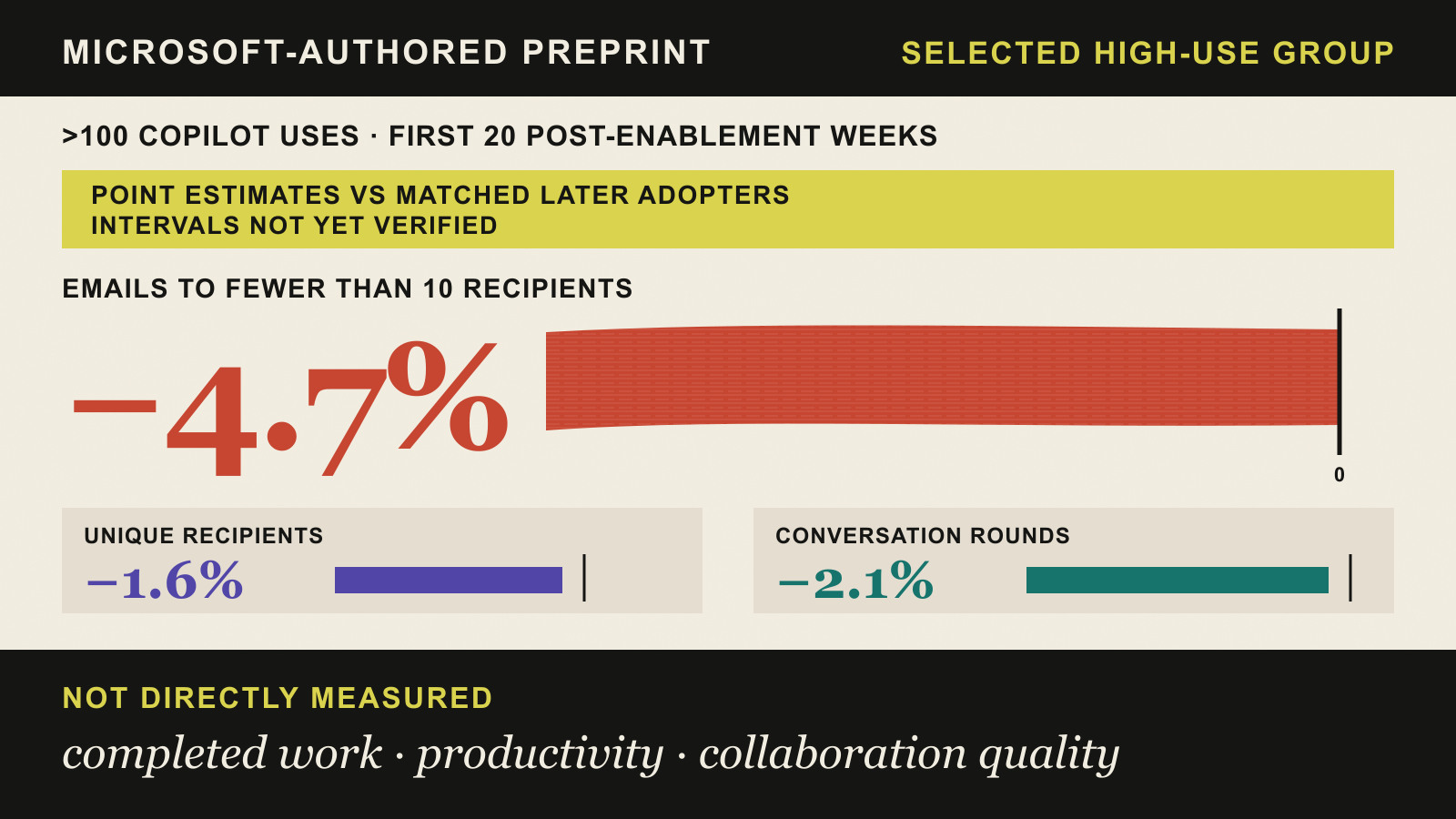
The study observes Microsoft 365 actions in 11 large companies. It does not measure completed work, productivity, collaboration quality or organisational transformation.