IBM surveyed 1,500 CHROs and 8,800 employees and found concern about judgement, skills erosion and hidden verification work. Self-reported gaps should lead to observed task evidence and redesigned decision rights, not a generic training response.
An ILO brief combines 21 purposively selected enterprise interviews with a survey of 1,591 professionals in China. Its self-reported gains are useful hypotheses, but workforce decisions need task baselines, comparison groups and job-quality measures.
Talogy reports that 78% of 207 HR and talent respondents worry AI may weaken future leadership skills. The result is a prompt to trace lost developmental experiences, not evidence that a leadership shortage has already occurred.
Spain’s IA360 roadmap combines governance, infrastructure, labour monitoring and adoption goals. Its decision value will depend on whether each promise is converted into a dated output, accountable owner and public evidence trail.
England recorded 160 foundation-apprenticeship starts in the first eight reported months, while employer familiarity with technical routes remained low. The bottleneck must be located before funding is scaled.
Baipu Industrial Park pairs advanced-packaging facilities with a validation lab and specialist training centre. The useful capability metric is validated transfer into production, not floor area or training seats.
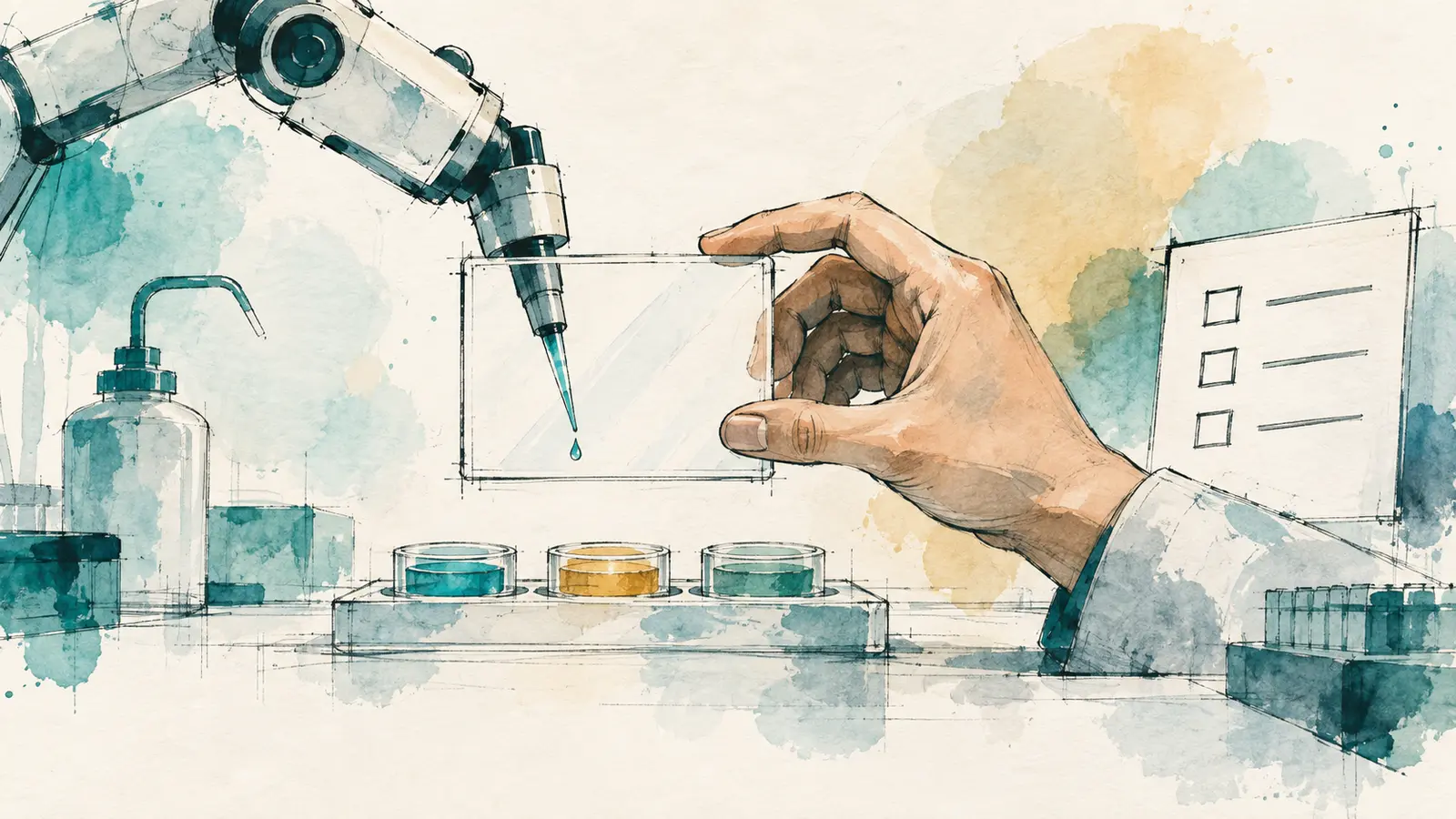
Anthropic confirmed a Bay Area wet lab and early work on automating experiments. The immediate workforce demand is for reproducibility, lab operations and human validation.
An IMF note says AI could lift European productivity by about 1% over five years while increasing energy and distribution pressures. Leaders should convert the headline into explicit capacity, adoption and inclusion gates.
Deloitte estimates UK workers spend nearly £1 billion a year on AI tools, while many users receive no training. Personal spending reveals unmet access and workflow demand—but it does not prove business value.
One senior vacancy combines agent engineering, sales operations and evaluation. It is useful evidence of a hybrid operating model, but one employer’s posting cannot establish broad demand.
A Pew survey across 37 countries finds expectations tilted toward job loss. Leaders should treat that sentiment as evidence about trust and change capacity, while keeping employment decisions tied to observed tasks and outcomes.
Only a third of surveyed employers said time to hire improved from 2025, while two thirds reported no change or a slowdown. The operating question is not whether a recruiter uses AI, but which stage actually releases or adds delay.
Global and LinkedIn data point to persistent underrepresentation in AI work and leadership. The actionable unit is not a generic pipeline promise, but the conversion and loss rate at each talent decision.
A new Brookings synthesis argues that exposure does not equal viable automation and that policy should track changes in expertise and opportunity. Employers can use the same logic: fund targeted pilots when measurable task, wage and mobility signals cross agreed thresholds.
Indian IT firms are reporting more outcome-linked deals as automation compresses effort. The commercial shift is real but limited: most AI pricing still measures effort or output, and disputed attribution can turn a promised outcome into a contract fight.
A UK careers discussion highlights resilient work in engineering, care, education and research. The useful decision is not to predict a safe occupation for 45 years, but to build transferable capability and evidence of adaptation.
Christine Lagarde warns that imported AI could create economy-wide leverage and says Europe’s capacity shortfall may grow sixfold. Sovereignty requires usable models, skills and exit options—not servers alone.
Almost 30% of surveyed workers used generative AI, yet employer training reached fewer than half. The sharpest signal is not adoption alone, but who gets access and who captures the saved time.
CompTIA estimated 86,000 more technology workers across the economy while technology companies cut about 14,700 positions. The apparent contradiction is a measurement lesson, not proof of an AI jobs boom.
A north-west England pilot connects short AI training with apprenticeships for young people outside work or education. Its value will depend on conversion, retention and task-level evidence.
Verdant estimates about 10,400 direct jobs across planned facilities; techUK projects 40,200 additional operational roles by 2035 under a growth scenario. Those are not the same population, baseline or time horizon.
A new study finds gaps in literacy, disciplinary application and responsible use across the UKRI-supported community. Its proposed user typology could turn fragmented provision into navigable pathways.
New graduate-outcomes figures show fewer computer science graduates entering coding roles. The data is a curriculum and early-career design signal, but it does not isolate AI as the cause.
US postings that mention AI skills rose 165% year over year, yet official business-use data remains uneven. The gap is a measurement warning for workforce planners.
A Taggd–CII report says 52% of surveyed GCCs plan to expand in FY27, while critical roles remain slow to fill and 80% offer generative-AI training. The numbers point to pipeline design, not a single shortage score.
The IT services group says AI-created productivity freed capacity equivalent to 20,000 employees and that people were redeployed. The decision signal is in the new work and outcome measures, not the headline number.
A new working paper models why broad access to AI may still leave productivity gaps intact. Human capital appears as a threshold for mobility, not a simple input with a guaranteed return.
The bank’s 2027 graduate materials now combine practical AI use with responsible application and judgement. The harder question is how candidates will demonstrate that capability fairly.
A five-country LinkedIn comparison finds a wider junior-hiring gap in occupations designed to combine AI-replicable and human skills, while broader declines argue against a simple AI-replacement story.
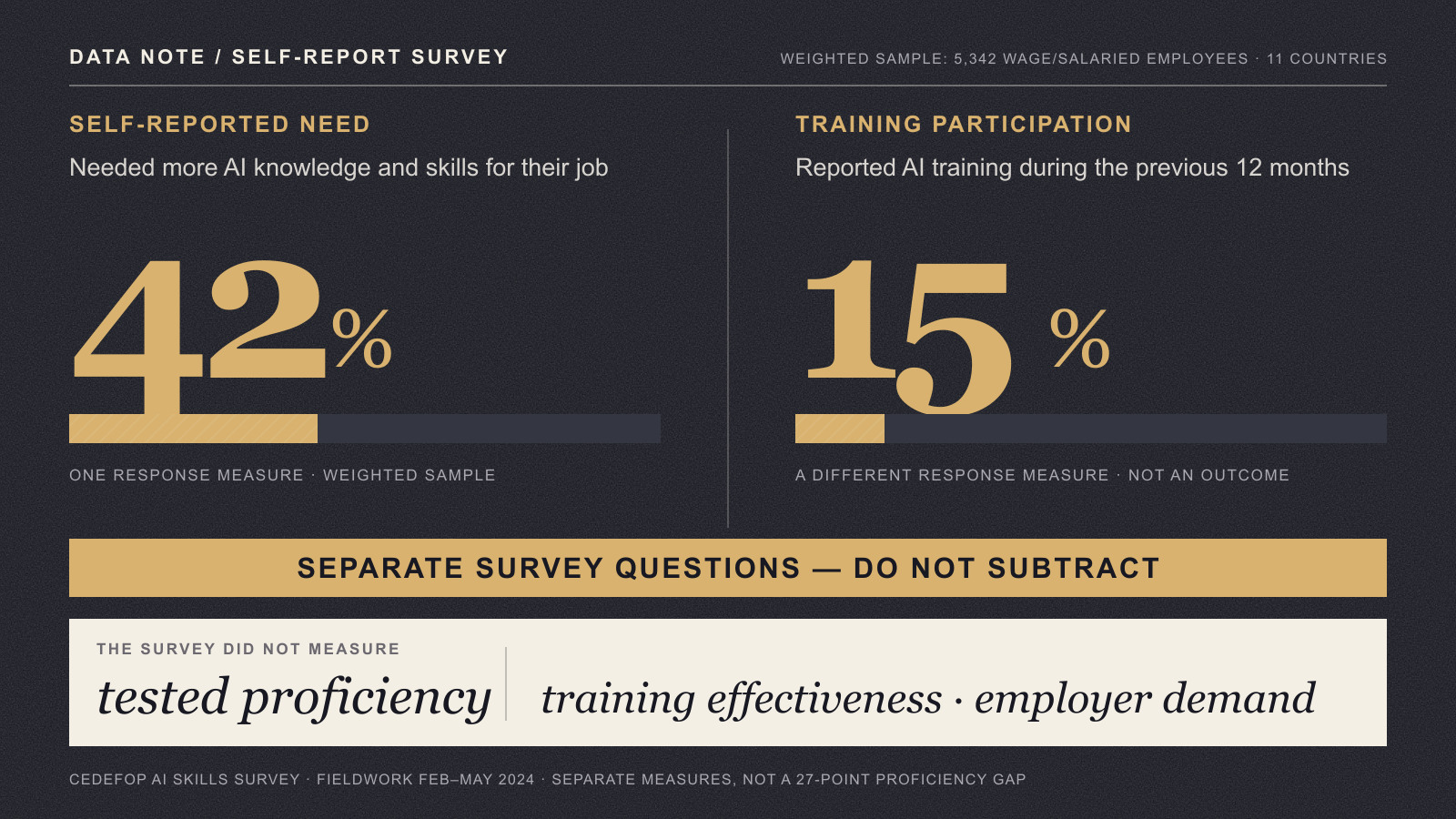
Cedefop surveyed 5,342 employees in 11 European countries. The result describes self-reported need and training participation—not tested AI proficiency or one universal curriculum.