An “AI-resistant” degree is a weak career strategy; adaptable task portfolios are stronger
A UK careers discussion highlights resilient work in engineering, care, education and research. The useful decision is not to predict a safe occupation for 45 years, but to build transferable capability and evidence of adaptation.
What happened
The Guardian published guidance on supposedly AI-resistant degrees, with a graduate-employment specialist arguing that adaptability is more credible than choosing a permanently safe profession.
Why it matters
Students, universities and employers need to design pathways around changing task mixes, human accountability and learning velocity rather than labels that promise immunity.
The search for an “AI-resistant” degree offers certainty that labour-market evidence cannot provide. In a 14 September Guardian feature, Jisc graduate-employment specialist Charlie Ball argues that it is hard to futureproof a 45-year career during rapid technological change and that students need a suite of skills that supports adaptation.
The feature identifies research, engineering, creative work, medicine, nursing and education as areas where physical context, accountability, empathy or original inquiry may preserve substantial human work. That is useful as a task-level hypothesis. It is not a ranking of safe degrees, and several claims in the article are expert judgments rather than measured forecasts.
Occupations are bundles, not shields
AI rarely encounters a job title as a single unit. It encounters tasks: searching, drafting, diagnosing, explaining, manipulating physical objects, negotiating, caring and accepting responsibility. A profession can retain strong demand while entry tasks, supervision ratios and routes to expertise change.
That matters most for early careers. Removing routine work may raise short-term productivity yet weaken the practice through which novices learn the exceptions. Universities and employers should therefore identify which tasks build judgment and preserve them as deliberate learning work, even when automation could complete them faster.
Physical presence and relationships also resist simple substitution, but they do not prevent augmentation. Engineers may use AI in modelling; clinicians may use decision support; teachers may use tutoring systems. The durable skill is not merely “being human”. It is the ability to frame a problem, verify machine output, work with affected people and own the consequence.
Build optionality that can be observed
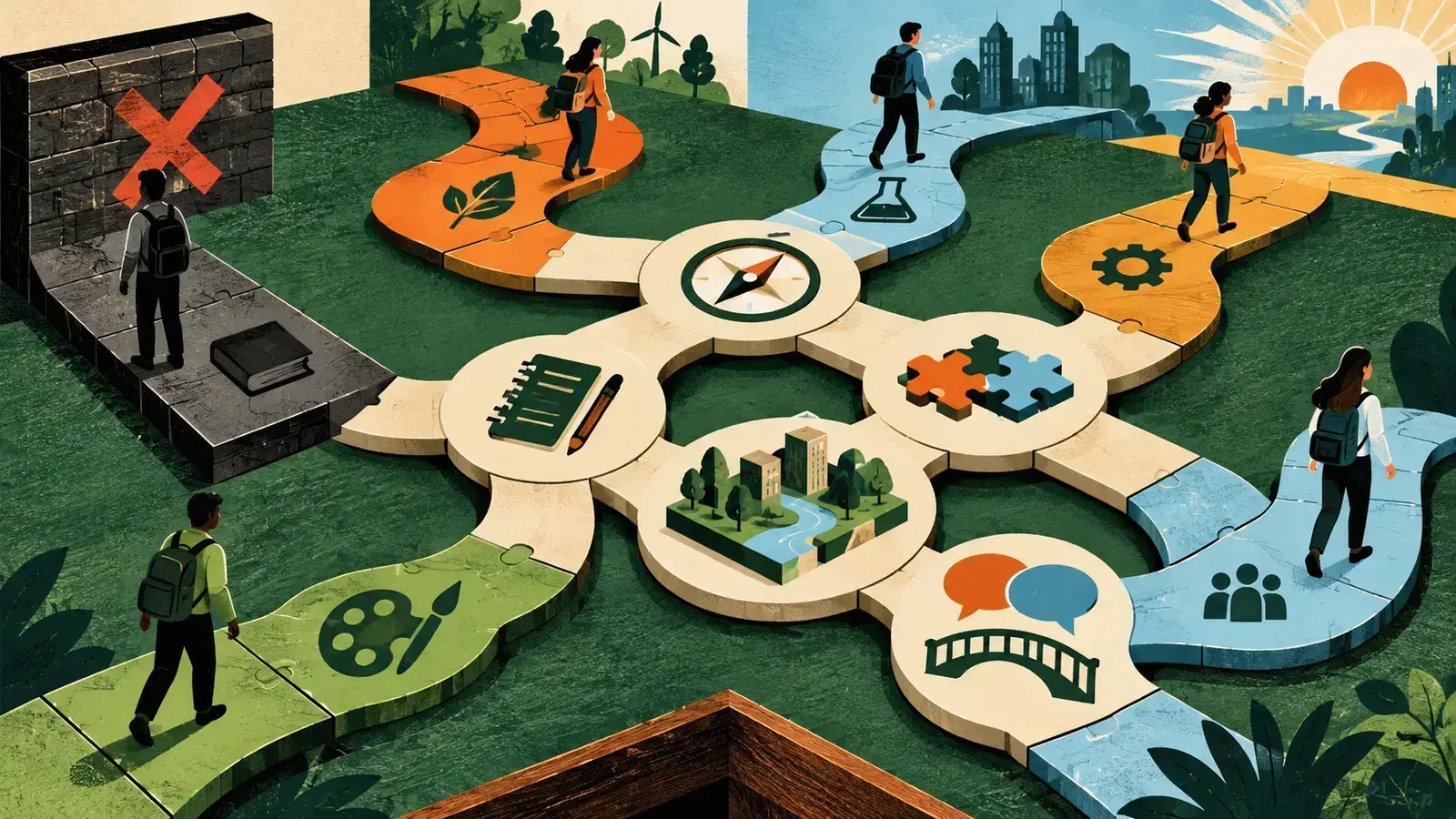
A stronger pathway combines three layers. First, deep domain knowledge: the concepts, standards and causal mechanisms that make error detection possible. Second, transferable operating skills: communication, quantitative reasoning, workflow design and evidence evaluation. Third, AI-specific practice: selecting tools, controlling data, testing outputs and escalating failures.
Students should seek programmes that expose all three and publish evidence of progression, not just module names. Employers can support this by defining entry roles with supervised stretch work rather than stripping every learnable task into automation. Education providers should update curricula from observed task change and placement outcomes, not from vendor forecasts alone.
There is a counterargument to the adaptability framing: telling individuals to remain flexible can shift the cost of structural change onto them. Not everyone has time, money, health or geographic mobility to repeatedly retrain. Policy and employers must supply paid learning, accessible transitions and credible labour-market information.
The Guardian article itself is limited. It presents expert advice, not a longitudinal study comparing degree outcomes under AI adoption. Assertions about future human preference and technical capability are uncertain. Its value is in refusing a false guarantee.
Use tools such as the Skills Atlas to compare adjacent capabilities, but treat every pathway as revisable. A good career decision should create options: domain depth, evidence of learning, access to real practice and the ability to move across task boundaries. The goal is not an AI-proof credential. It is a portfolio that can absorb change without starting from zero.
A minimum evidence package
Before scaling the change, the responsible team should preserve the exact source, model or policy version, the affected workflow, baseline, decision owner and review date. It should state what would count as success, what would count as a material failure and who can stop the use. Results should separate technical performance from adoption, business outcome and distribution across affected groups. Where evidence is incomplete, the scope should remain bounded and reversible. This discipline does not decide the policy or product question in advance. It makes the next decision auditable and allows a later reviewer to distinguish new evidence from a changed assumption. The organisation should also retain an accessible human route for challenge whenever the system materially affects work, opportunity or rights.