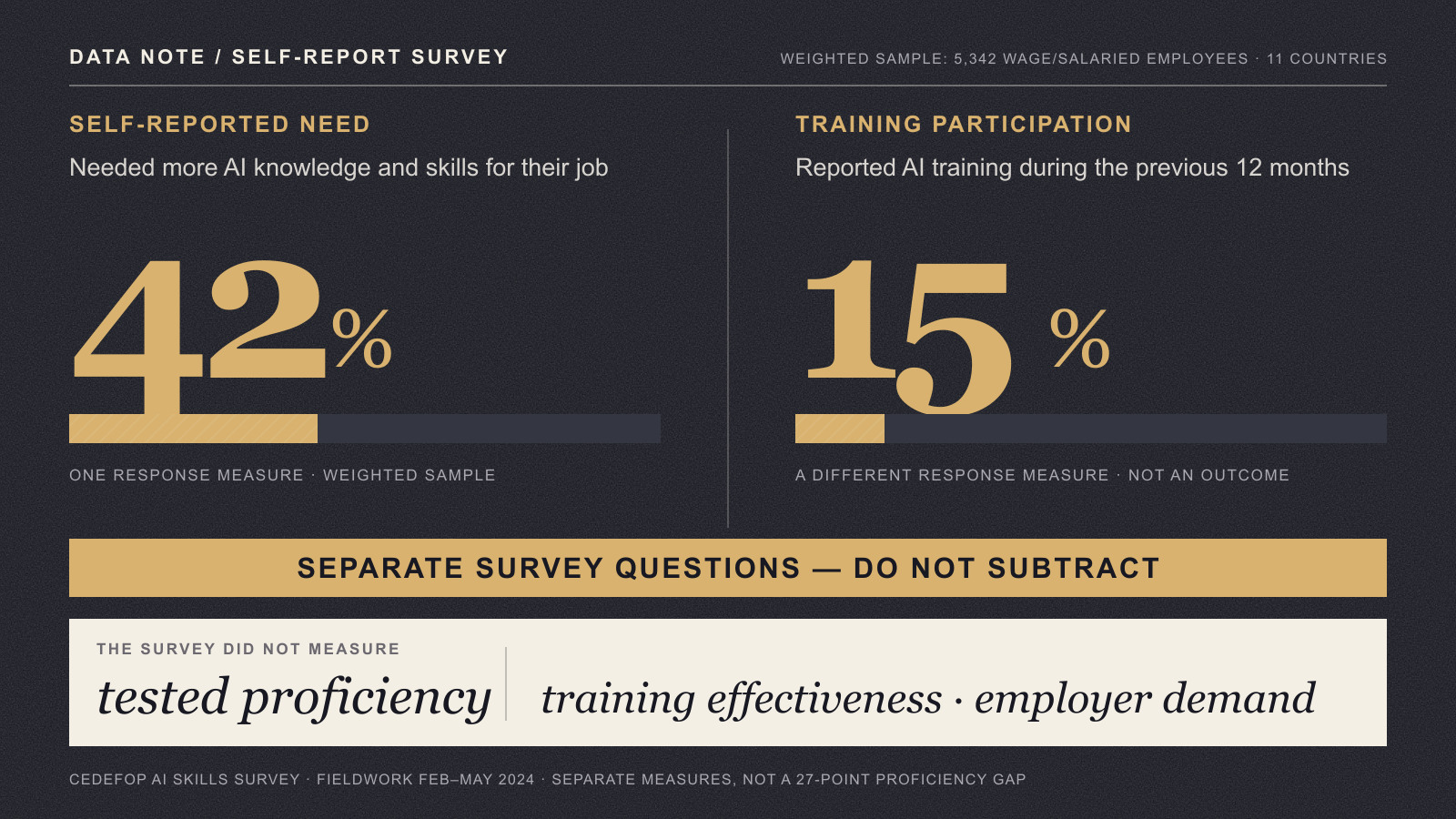
42% said they needed more AI skills; 15% had trained
Cedefop surveyed 5,342 employees in 11 European countries. The result describes self-reported need and training participation—not tested AI proficiency or one universal curriculum.
What happened
A 2026 ETF-led synthesis brought renewed attention to Cedefop's 2024 AI Skills Survey, in which 42% of sampled employees reported needing more AI knowledge and skills while 15% reported recent AI training.
Why it matters
The two percentages may help frame a learning measurement question, but the survey design does not turn them into a tested proficiency gap, an employer-demand estimate or evidence for one curriculum across roles.
The headline numbers come from Cedefop's 2024 AI Skills Survey, not from a new 2026 labour-market measurement. Among 5,342 sampled wage and salaried employees, 42% said they needed to develop their AI knowledge and skills for their job. Fifteen per cent said they had participated in AI training during the previous 12 months.
- 42%: needed to develop AI knowledge and skills for the job.
- 15%: participated in AI training during the previous 12 months.
These are separate questions and the values should not be subtracted.
Those results describe what respondents reported. They do not measure whether a person can perform an AI-related task, judge an output correctly, use data safely, or apply a governance control. The survey also did not ask employers to quantify vacancies or skill requirements. It therefore provides neither a tested proficiency rate nor a direct estimate of employer demand.
Who was surveyed
Verian administered the survey through probabilistic push-to-web panels between February and May 2024. Respondents were employees aged 16 to 64 in Belgium, Czechia, Germany, Ireland, Greece, Spain, France, Luxembourg, Poland, Portugal and Slovakia. The design recruited approximately 500 people per country and 250 in Luxembourg, then applied weights. Self-employed people and family workers were excluded.
The denominator and geography matter. This is a weighted sample of employees in 11 countries, not the whole EU27 workforce, all people in work, a vacancy census or a sample of employers.
Nine self-assessments, not one proficiency score
The survey used nine AI-literacy items. Each asked respondents how well they knew or could explain a particular aspect of AI. Depending on the item, 40% to 62% answered that they knew it “not well or at all”. These are separate self-assessments. The public brief does not report a performance test, and the nine responses should not be collapsed into a single validated score.
The same boundary applies to training. Participation in a course is an activity measure; it does not show that the course changed capability, work quality or behaviour. Conversely, no reported training does not prove that a respondent had no AI knowledge, because learning can occur outside a formal programme.
What the 2026 report adds
The August 2026 *Changing landscape of skills in the age of AI* report was prepared by the European Training Foundation with contributions from Cedefop, Eurofound, the European Commission, the International Labour Organization and UNESCO. It describes itself as a brief review and synthesis of existing institutional work. Its discussion of AI literacy is useful context, but it is not a new survey and should not be cited as the origin of the 42% and 15% results.
Cedefop's policy brief is dated 30 January 2025 and identifies the fieldwork window, sample and weighting at a high level. The public PDF shows no explicit revision history. This article does not rely on a complete technical questionnaire, weighting file or microdata, and no external survey-methods specialist opinion is represented.
Questions before setting a learning baseline
- Which AI-related tasks and decisions actually recur in each role?
- Which of the nine self-reported areas require demonstrated performance rather than awareness?
- How will training participation be kept separate from measured capability and work outcomes?
- Which groups and countries are missing before a result is treated as organisation-wide or European?