A Microsoft preprint estimates fewer small-group emails among selected heavy Copilot users
The study observes Microsoft 365 actions in 11 large companies. It does not measure completed work, productivity, collaboration quality or organisational transformation.
What happened
A Microsoft-authored preprint compared recorded Microsoft 365 activity before and after Copilot enablement, using later adopters as matched controls.
Why it matters
The manuscript reports a change in recorded activity but, by its own measures and limitations, does not establish whether reduced email was more efficient or less collaborative.
A Microsoft-authored preprint reports changes in recorded Microsoft 365 activity after Copilot enablement. For selected high-use participants, it estimates fewer small-group email actions alongside increased activity in document-oriented applications.
The recorded outcomes are application actions, not completed tasks, accepted work products or time saved. The paper does not establish whether less email removed low-value coordination, weakened useful contact or shifted communication to a channel outside the dataset.
Who and what the study measures
The dataset covers January to September 2024 in 11 large international companies. The paper does not disclose the countries or report country-level results. It includes 40,164 users enabled for Copilot; 7,831 used it more than 100 times in their first 20 weeks. The focal group is therefore defined by post-enablement use and is not the full enabled population.
Researchers compare ten weeks before enablement with twenty weeks after it. Later adopters serve as controls, matched on earlier activity and whether a worker was a manager or individual contributor. Users must have recorded activity in at least 25 of the 30 observed weeks. Copilot-generated actions are excluded from the outcome counts.
Microsoft groups Word, Excel, PowerPoint, Loop and OneNote as productivity applications, and Outlook, Teams and Streams as communication applications. These are product-based analytical labels. The study does not measure the value, difficulty or collaborative content of the recorded actions.
The reported shift
For the group with more than 100 Copilot uses, the model estimates a 21.2% increase in human-triggered actions in the productivity-labelled applications and a 7.1% increase in communication-labelled applications relative to matched later adopters. Those figures describe application activity in the selected sample, not a measured productivity outcome.
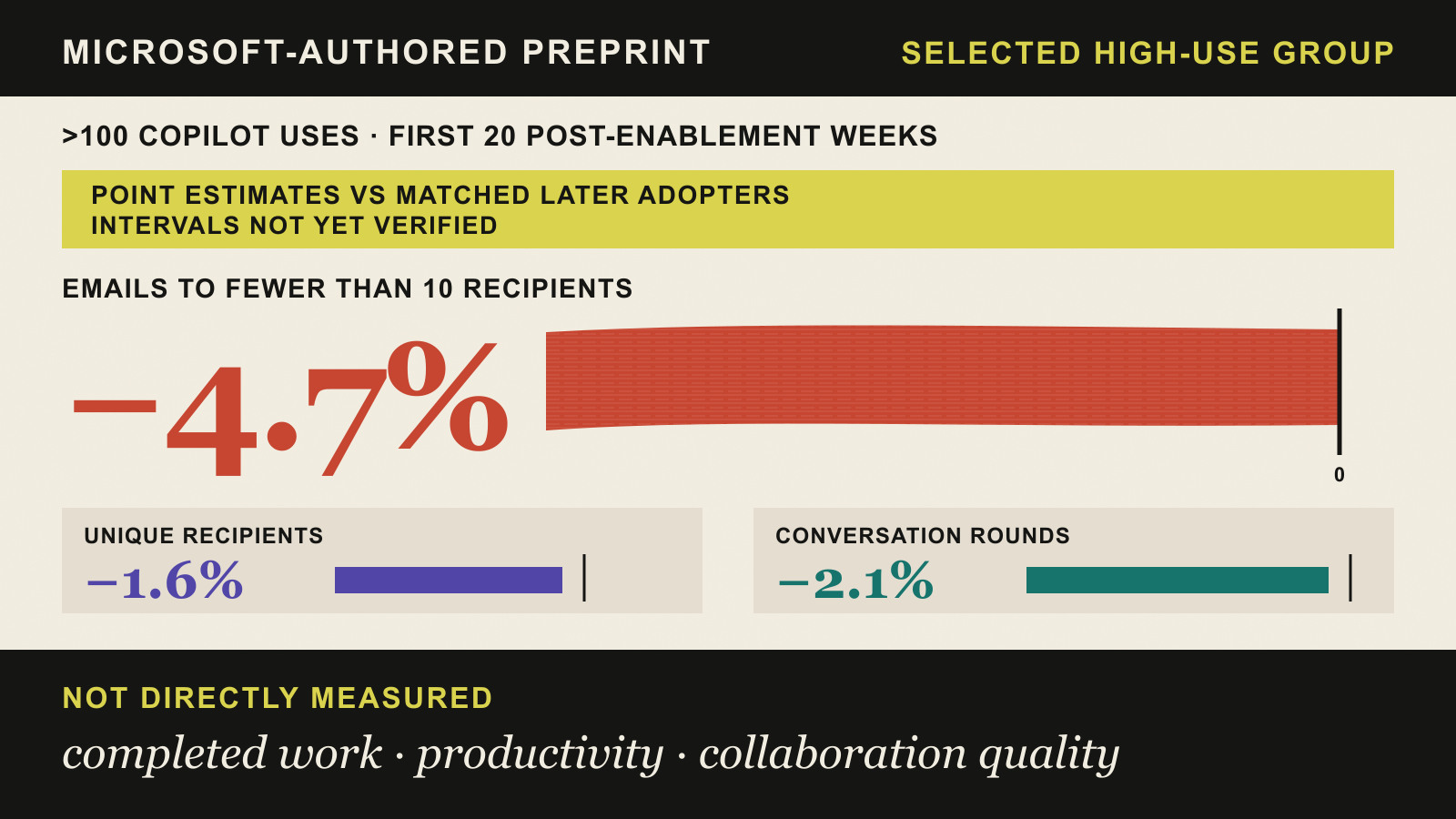
A separate dataset examines emails sent to fewer than ten recipients. For the same selected high-use group, the paper reports these point estimates:
- Small-group emails: -4.7%.
- Unique recipients: -1.6%.
- Conversation rounds: -2.1%.
The selected group exceeded 100 Copilot uses in the first 20 post-enablement weeks. These are point estimates; intervals are not verified for this publication. The authors also report that some Outlook actions increased and say they could not determine which reduced messages were valuable or redundant.
What remains unknown
The authors acknowledge that they do not directly measure time allocation or a complete productivity outcome. The study does not observe whether documents were finished, accepted or improved; whether teams made better decisions; or whether communication moved to other channels. Its closed dataset has no public reproduction, all authors have Microsoft affiliations, and the manuscript is not peer reviewed.
The treatment definition depends on later Copilot use. Matching and difference-in-differences are the paper's identification strategy, but the reported estimates remain bounded to selected high-use participants and are not presented as representative of all enabled workers. This publication does not reproduce the confidence intervals, pre-trend evidence, robustness tables or supplemental covariance analysis.
The bounded result is a reported shift in Microsoft 365 actions for this selected sample. Because the paper does not measure completed output, quality, time saved or collaboration outcomes, the estimates do not constitute measured evidence of productivity or organisational transformation.